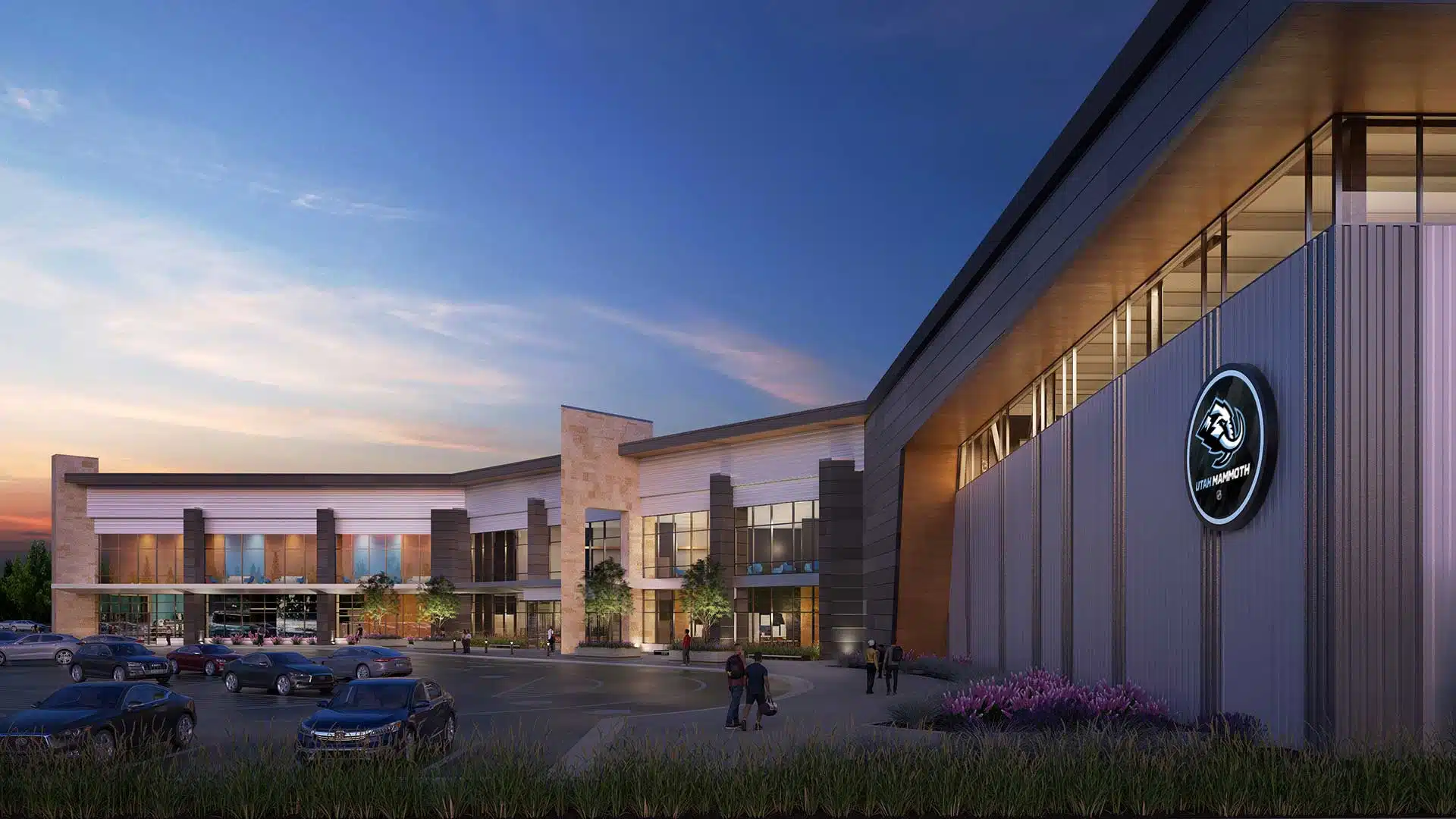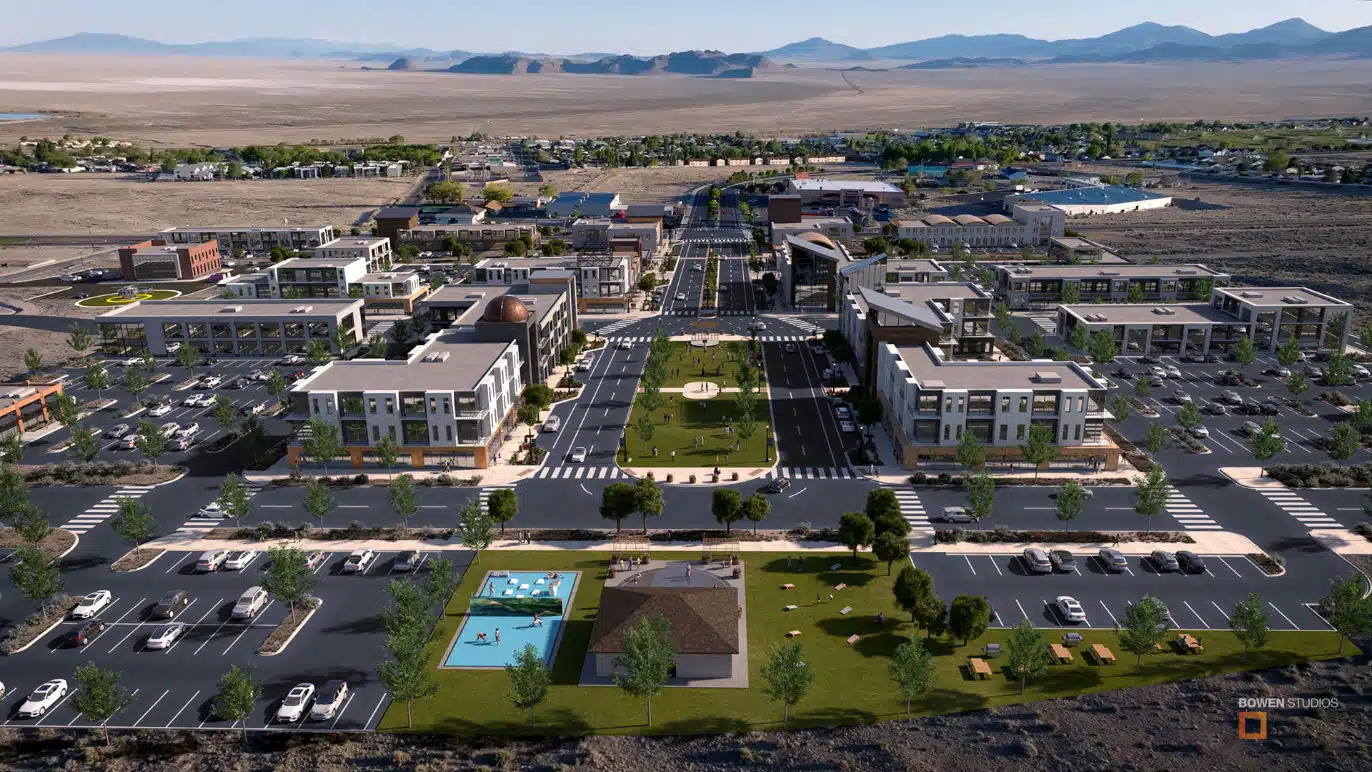


Every week now, someone asks us a version of the same question: Couldn’t we just do this with AI renderings?

It’s a fair question, and it deserves a straightforward answer. We’ve been producing architectural renderings and animations for more than twenty years. We also use AI tools in our own studio most days. So we’re not going to tell you AI images are worthless. They aren’t.
What matters is understanding what AI is actually good at, where it falls short, and which approach makes sense for your project. AI generates something that looks like your building. A rendering studio produces your building. Most of the confusion around AI rendering comes from treating those as the same thing. They aren’t.
What AI Image Tools Are Genuinely Good At
Exploring an idea before you’ve committed to one
The earliest phase of design is cheap to change and expensive to stall. This is one area where AI can be incredibly useful. Feed a rough massing sketch into an image model, and you can explore forty directions in an afternoon. Try a heavier base. Lighten the roof. Warm up the brick. Add more glass. Take some glass away.
None of those images need to be buildable yet. That’s not the point. This is essentially the sketchbook stage of the process, and having a sketchbook that can generate ideas in seconds can be a real advantage for a design team.
Establishing mood before you establish geometry
Design conversations often stall because the client and architect are using the same words while picturing completely different things. Warm. Modern. Timeless.
AI gives you a fast way to put images on the table and figure out what those words actually mean to the person paying for the project. We’ve seen a five-minute AI exercise settle a debate that had dragged on through email for three weeks.
Keeping momentum in the room
There is real value in being able to ask what the entry might look like on the other side of the building while everyone is still sitting at the table.
AI makes that possible. It won’t necessarily be accurate, and everyone in the room understands that. That shared understanding is exactly what makes it useful at this stage.
Low-stakes internal visuals
Placeholder images in a working presentation. A quick visual for an internal team. Concept art that nobody is going to use to make a final decision.
When an image is staying inside the building, the standard is different. AI can handle this type of work extremely well. All four of these uses have something important in common. The image is describing a possibility rather than representing a commitment.
Where AI Breaks Down
It generates. It doesn’t represent.
This is the root of almost every other problem. Your building has dimensions. It might have a 34-foot glass curtain wall, a nine-inch reveal, a setback the city debated for two months, and mullion spacing that the facade consultant spent a week resolving.
An image model doesn’t actually know any of that. It produces something visually plausible based on what it has learned from other buildings. The result may look remarkably similar to your design, but similar isn’t the same as accurate.

There’s a simple way to test this. Ask for another view of the same building.
Suddenly the window count changes. The roofline moves. A material from the north wall appears somewhere else. Details that looked convincing in the first image become completely different in the second.
That’s not really a rendering problem. It’s simply how the technology works. There isn’t a complete model of your building sitting behind the image.
A rendering built in our studio starts with your Revit, SketchUp, Rhino, or CAD file. When we move the camera, the building stays the same because the geometry actually exists inside the software. That’s more than a stylistic difference. It’s a fundamental difference in what the image represents.
Your specifications don’t always survive
Interior designers tend to notice this problem quickly. You may have specified a particular quartz, a specific wool in a particular weave, or a brushed finish with an exact sheen.
AI can give you a quartz, a wool, and a brushed finish. It might even look fantastic. The problem is that it may not be what you specified. If the client falls in love with a finish that isn’t actually part of the package, the image has created a problem rather than solved one.
Getting materials right in an architectural rendering involves much more than matching color. Reflectance, sheen, texture, scale, and the way light reacts with a surface all matter.
A honed stone handles light differently from polished stone. Matte lacquer holds highlights differently. Wood veneer needs the correct grain and scale to look right at the size it will actually be milled.
That work comes from real specifications and real samples. It’s the difference between an interior rendering that supports the design specification and one that quietly competes with it.
Real light on a real site
Sun angle isn’t simply an artistic choice. It’s determined by latitude, orientation, date, and time of day. On many projects, those details are an important part of the design itself.
How does the courtyard perform in February? Does the west facade need additional shading? What happens to the neighboring property in the afternoon once the building is constructed?
AI can create beautiful light. That doesn’t mean the light is accurate. When sunlight is there simply to make an image look appealing, that’s usually fine. When sunlight is being used as evidence, accuracy matters. That’s why daylight and shade simulations are based on actual solar data rather than an image prompt.
Consistency across a set
A launch package usually isn’t a single image. It might include 12 or 20 exterior images at different times of day, several interior images, an amenity deck, an aerial view, and a lobby. Every image needs to show the same building, finishes, landscaping maturity, and overall design.
Maintaining continuity with AI is difficult because each new generation introduces another opportunity for change. Reference images and detailed prompting can help, but you’re still working to reconcile a collection of images that were generated independently. Build the building correctly once, and that problem largely disappears.

A professional rendering studio works from one coordinated model, which creates consistency from image to image. The architecture stays the same. Materials stay the same. Landscaping, lighting, furnishings, and details remain consistent throughout the entire set. Build the project correctly once, and every view comes from the same source. That level of consistency is difficult to replicate when each image is generated separately.


Animation makes consistency even more important. A thirty-second architectural animation contains roughly 900 frames. Every one of those frames needs to agree with the next. Continuity isn’t an added benefit in animation. It’s fundamental to the deliverable.
Resolution, print, and the sales center wall
Architectural renderings don’t always stay on a computer screen. They end up on large walls behind leasing desks, on trade show displays, in printed offering memorandums, in presentations, and in sales center graphics.
An AI image enlarged to that scale can begin falling apart in exactly the places people tend to examine closely. Railings, soffit edges, signage, fixtures, and architectural details can lose definition or reveal inconsistencies. A professionally produced rendering from actual geometry can be created at the resolution the final application requires because the underlying detail exists in the model.
Someone needs to stand behind the image
This may be the most important distinction. A design review board might ask whether the massing shown in your presentation matches the submitted plans.
A lender might ask whether the rendering in an offering memorandum accurately reflects the approved project.
A buyer standing in a sales center might ask whether the view shown from the eleventh floor is actually what they should expect. You need to be able to answer those questions confidently. More importantly, someone needs to be able to demonstrate how the image was created using the model, survey, camera position, specifications, and site conditions.
A prompt can’t provide that accountability. When an image is being relied on by someone making a decision involving money, approvals, leasing, or purchasing, it needs to come from something that can be verified.
One Question That Settles It
Before deciding which approach makes sense, ask one question. Is this image exploring an idea or committing to one?

| The image is for | Use |
|---|---|
| Early concept exploration, massing options | AI |
| Aligning on mood, palette, character | AI |
| Internal decks and placeholders | AI |
| Design review boards and entitlement | Studio |
| Investor decks, lenders, offering memoranda | Studio |
| Presales, leasing, sales center display | Studio |
| Anything a client will hold you to | Studio |
| A coordinated marketing set | Studio |
| Animation, virtual tour, or VR | Studio |
| Print, large format, or exhibit scale | Studio |
When you’re exploring, AI may be the fastest sketchbook ever created. When you’re committing to a design, the image needs to come from your actual model because once someone relies on it, close enough can become a liability.
What Twenty Years Buys That a Prompt Doesn’t
One thing often gets overlooked in conversations about AI. The hardest part of architectural visualization was never simply knowing how to operate the software.
The difficult part is knowing where to put the camera. It’s knowing whether a building feels stronger from eye level or from above. It’s deciding whether twilight actually improves the story or is simply being used because it looks dramatic.
It’s knowing what to leave out. Most importantly, it’s knowing which image out of the hundred images you could create actually makes the strongest case for the design.
When we visualized the Formula 1 Las Vegas Grand Prix before a single tire hit the track, the technical execution obviously mattered. But those images also needed to build anticipation. Someone had to decide what the story was before the rendering process began.
That’s art direction. It’s judgment developed through years of seeing which images change the conversation and which ones simply look nice.
A prompt doesn’t replace that judgment because that isn’t really what a prompt is designed to do.

Where AI Goes Next
The boundary between AI and traditional visualization isn’t fixed. Some of the most interesting developments happening now involve AI tools that understand or reference actual project geometry rather than inventing everything from scratch.
We’re watching that development closely because it could significantly speed up parts of our own workflow. What’s interesting is where the technology is heading.
It’s moving toward the model. The model still matters because it can be checked, revised, and defended. Those qualities matter when an image needs to represent a real project rather than simply an idea.
The Practical Take
Use AI when you’re exploring ideas, aligning a team, or moving quickly on something that isn’t intended to represent a final commitment. It’s genuinely useful for that. Design teams that completely ignore these tools are giving up significant potential speed.
Bring in a rendering studio when the image needs to be accurate, consistent, defensible, and capable of supporting a real decision. That might be an approval, a lease, an investment raise, or a sale. Most projects can benefit from both approaches at different stages. The important part is knowing which stage you’re in.
Have a project where the image has to hold up?
We’ve been building renderings, animations, and virtual tours that do exactly that for over twenty years, from our studio in Salt Lake City. Get a quote or call 385-257-3559.